Artificial intelligence is quickly becoming part of everyday business, including the legal industry. People are using it to draft emails, analyze and summarize large datasets, brainstorm strategies, automate routine tasks, and ask it to do a myriad of other tasks. One thing is for sure: the technology is powerful and now, ubiquitous.
But most of the business world isn’t subject to strict confidentiality rules when it comes to sharing information about a client or a case. And here lies the quandary for lawyers and law firms. If a lawyer asks a third-party AI agent to analyze and summarize a large set of client records, for instance, would that law firm breach the confidentiality rules? What if the client did it instead? As one recent federal court decision makes clear, convenience does not replace confidentiality.
A new ruling from the Southern District of New York is a recent reminder to the legal industry that using public AI platforms for legal research, case preparation, or strategic discussions may put attorney-client privilege and work-product protections at risk. If you’re a lawyer trying to get a leg-up with a slip and fall claim in Las Vegas or a Reno tractor-trailer accident, understanding how AI affects privilege matters more than ever.
What Happened in United States v. Heppner
United States v. Heppner is one of the first rulings to directly address whether prompts and outputs sent to and received from a public chatbot (operated by a third-party) can be protected by the attorney-client privilege. The Heppner case involved a 2025 criminal indictment filed in the United States District Court for the Southern District of New York. During the discovery portion of the case, federal investigators obtained 31 documents containing communications between the defendant and a version of Anthropic's Claude AI platform.
The defendant argued that those materials should be protected by the attorney-client privilege and the work-product doctrine. In a motion filed on February 6, 2026, prosecutors asked the court to rule that the AI-generated materials were discoverable. Just days later, Judge Jed S. Rakoff agreed with the prosecutors (first in an oral ruling from the bench, then in a written opinion issued on February 17, 2026) that the information obtained from Anthropic was not protected material.
The court's message was clear: simply involving AI in legal research does not automatically confer privilege protection on whatever data was submitted to or produced by the AI.
Why Attorney-Client Privilege Didn't Apply
To qualify for attorney-client privilege, a communication generally must involve:
An established client and an attorney relationship;
A communication made for the purpose of obtaining or providing legal advice or services;
An expectation that the communication will remain confidential.
According to the court, the defendant's AI communications failed all three.
1. AI Is Not Your Lawyer
The Government pointed out the obvious but legally significant fact that Claude "has no law degree and is not a member of the bar," and owes no duties of loyalty or confidentiality to users (Government's Motion, U.S. v. Heppner, 1:25-cr-00503-JSR (S.D.N.Y. Feb. 6, 2026), Dkt. No. 22, at 8). Without an attorney on the other end of the communication, the privilege argument started on shaky ground.
This distinction matters in any case where you're working with a real Las Vegas personal injury attorney with over 20 years of experience, like Daven Cameron, not an AI-generated lawyer. Your conversations with a licensed counsel carry protections that AI chats simply cannot offer. And at this point, the law has yet to recognize any legal protections arising from the use of AI platforms.
2. The Platform Wasn't Designed to Give Legal Advice
Anthropic's own published materials state that Claude is designed to avoid providing "specific legal advice" (Government's Motion at 8) and instead directs users to consult qualified counsel.
That made it difficult for the defense to argue that the conversations were made for the purpose of obtaining free AI legal advice in the traditional privileged sense.
The problem with this argument, though, is that lawyers have been using computer programs (essentially what AI platforms are) from the very beginning of the Internet age. As early as 1990, Westlaw, for example, was offering its case search function through a rudimentary version of the internet. However, obtaining a list of cases that might apply to the issue you're researching is a far cry from asking Claude for specific legal advice.
3. Confidentiality Was Never Assured
This may have been the most damaging issue.
The defendant used the public, free-tier version of Claude. According to Claude AI's privacy terms, user inputs and outputs may be used for training purposes and may be disclosed to third parties, including governmental authorities (Government's Motion at 9).
Judge Rakoff found that those terms undermined any reasonable expectation of confidentiality.
#cta_start
Your Case Deserves Real Counsel, Not a Chatbot
Before your next conversation about your case happens anywhere, whether online, in a free app, or in court, talk to our Las Vegas or Reno personal injury attorney who actually owes you confidentiality.
Sharing AI Research with Counsel Didn't Fix the Problem
The defense also argued that because the materials were eventually shared with counsel, they should be protected. The court rejected that argument.
The Government compared the AI conversations to internet searches, or books checked out from a library. Research conducted independently does not suddenly become privileged simply because someone later discusses it with an attorney (Government's Motion at 4). Judge Rakoff agreed.
Could AI Ever Fall Within Privilege?
Interestingly, the court left the door slightly open for a privilege to apply to the use of AI. Judge Rakoff noted that the "purpose" element presented a closer question because defense counsel argued the defendant was gathering information to prepare for conversations with his attorney (Memorandum Opinion, U.S. v. Heppner, No. 25-cr-00503-JSR (S.D.N.Y. Feb. 17, 2026), Dkt. No. 27, at 7).
Ultimately, however, the court focused on one critical fact: the defendant acted independently with no direction from his lawyer. The opinion suggests the outcome might have been different had counsel specifically requested that the client perform certain research tasks. In that situation, the AI platform could "arguably" function more like a professional agent working under attorney supervision (Memorandum Opinion at 7).
The Work Product Doctrine Failed for Similar Reasons
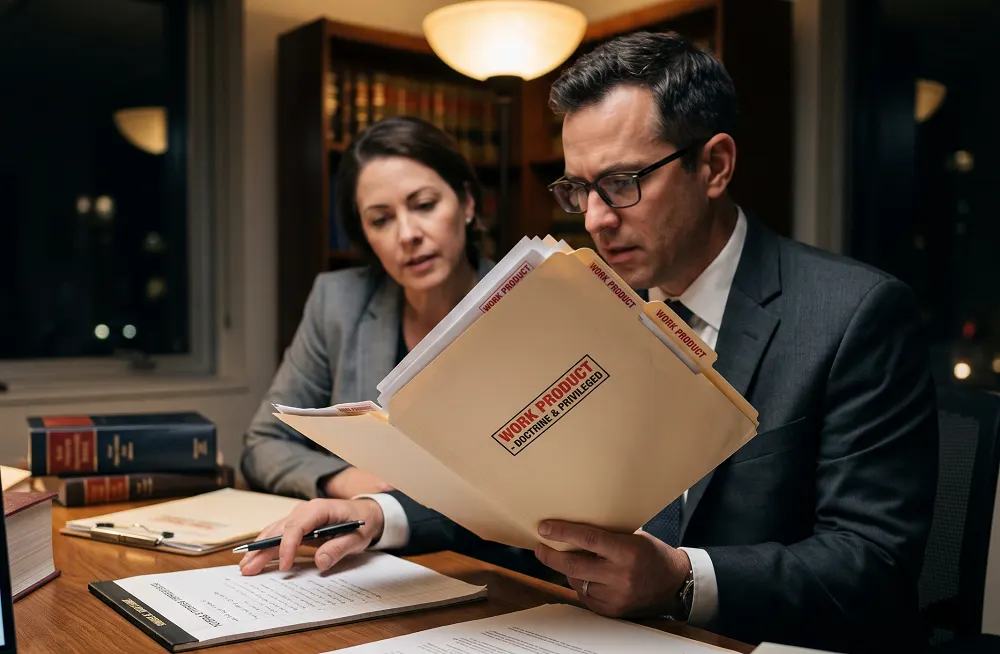
The defendant also argued that the documents were protected as attorney work product. That argument failed as well.
The work product doctrine generally protects materials prepared by or at the direction of counsel in anticipation of litigation (Memorandum Opinion at 7).
Here, there was "no dispute" that defense counsel did not instruct the defendant to conduct the Claude searches, and the materials did not reflect counsel's legal strategy (Memorandum Opinion at 9 and Memorandum Opinion at 12).
Without attorney involvement, the protection did not apply.
What Lawyers, Businesses, and Clients Should Take from This
AI is not going away. Nor should it. But this case is a strong reminder that new technology does not rewrite old legal principles. Before using AI in connection with legal strategy, consider a few practical safeguards:
Use Secure, Enterprise-Level Platforms
Consumer-grade AI tools often reserve broad rights over user data. Review the privacy terms of legal artificial intelligence software carefully. Training on confidential information should be prohibited, and third-party disclosures should be tightly controlled.
Keep Counsel in the Loop
AI-assisted legal analysis should be directed, supervised, and documented by counsel whenever privilege protections are at issue. Heppner makes clear that independent experimentation can create unnecessary exposure. If you're handling something as serious as a brain injury claim, a wrongful death case, or a motorcycle accident matter, talk to your attorney before running anything sensitive through an AI tool.
Assume Every Prompt Could Be Discoverable
Every prompt, every follow-up, and every batch of AI-generated questions you send to a public model should be treated as a potential exhibit. Prompts, outputs, summaries, and uploads should all be treated like documents that could someday appear in litigation. Internal workflows, labeling, access controls, and documentation matter more than ever.
Technology Should Strengthen Decisions, Not Compromise Confidentiality
AI can be a useful tool when used responsibly. But as Heppner shows, when legal strategy meets public technology platforms, convenience without oversight can come at a very real cost.
If you've been injured in an accident and have questions about how technology, evidence, or communications could affect your case, the team at Cameron Law is here to help. We handle car accidents, truck accidents, pedestrian accidents, and the full range of personal injury matters across Nevada.
The Bottom Line: Treat AI Like a Tool, Not a Substitute
As more cases of first impression involving this issue are tested at the trial level and in appellate courts, the boundaries of when the rules of confidentiality and attorney work-product may be expanded.
AI will continue to reshape how people gather information, but the Heppner case and similar cases show that no algorithm can replace the duties a real attorney owes a client. Confidentiality, loyalty, and privilege still come from licensed counsel, not a chat window.
If you've been injured and need legal guidance from a real lawyer with advanced knowledge and skill, the team at Cameron Law is ready to help. Reach out to our firm today.
We want to change the way people view lawyers, one relationship at a time. ®
Frequently Asked Questions About AI and Attorney-Client Privilege.
Does using ChatGPT or Claude waive attorney-client privilege?
Using a public AI chatbot on your own and without your attorney directing you to do so likely does not create privilege in the first place. In United States v. Heppner, a United States District Court held that communications with a free version of an AI platform were discoverable by prosecutors because no attorney was involved, no formal legal advice was given, and there was no reasonable expectation of confidentiality under the platform's terms of service.
Can my lawyer use AI without waiving privilege?
Yes. When an attorney (or someone who works with or for that attorney) uses a secure, enterprise-grade AI platform under appropriate confidentiality terms, and the use is part of providing legal advice, privilege protections can still apply. The Heppner opinion even hinted that AI tools used at counsel's direction may function more like a supervised professional agent.
What should I do if I have already discussed my case with a public AI tool?
Tell your attorney as soon as possible. Anything you typed into a public AI service may not be protected and could potentially be discoverable. Your attorney can assess the exposure and plan accordingly. If you don't have counsel yet, schedule a free consultation with Cameron Law before discussing the matter further.
Are AI conversations protected as work product?
Only if the materials were prepared by or at the direction of counsel in anticipation of litigation. In Heppner, the work product argument failed because defense counsel had not instructed the client to use the AI tool, and the output did not reflect any attorney's strategy.
What's the difference between confidentiality and privilege when using AI?
Confidentiality is about whether information is kept private in a legal practice. Privilege is a legal protection that prevents the other side from forcing disclosure of protected information for use in court. A public AI tool may offer neither, and the Heppner case shows that without an attorney directing the use, privilege almost certainly won't attach.
Find the top truck accident lawyers in Las Vegas, known for their expertise, results, and commitment to securing maximum compensation for injury victims.
Injured in a weather-related accident in Las Vegas or Reno, Nevada? Discover how liability is determined & your legal rights. Get a free case review today!